Behavioral evaluations offer clearer insights for AI coding agents
Google Developers Blog outlines how behavioral evaluations provide actionable feedback for AI agent development, moving beyond opaque end-to-end benchmark scores.
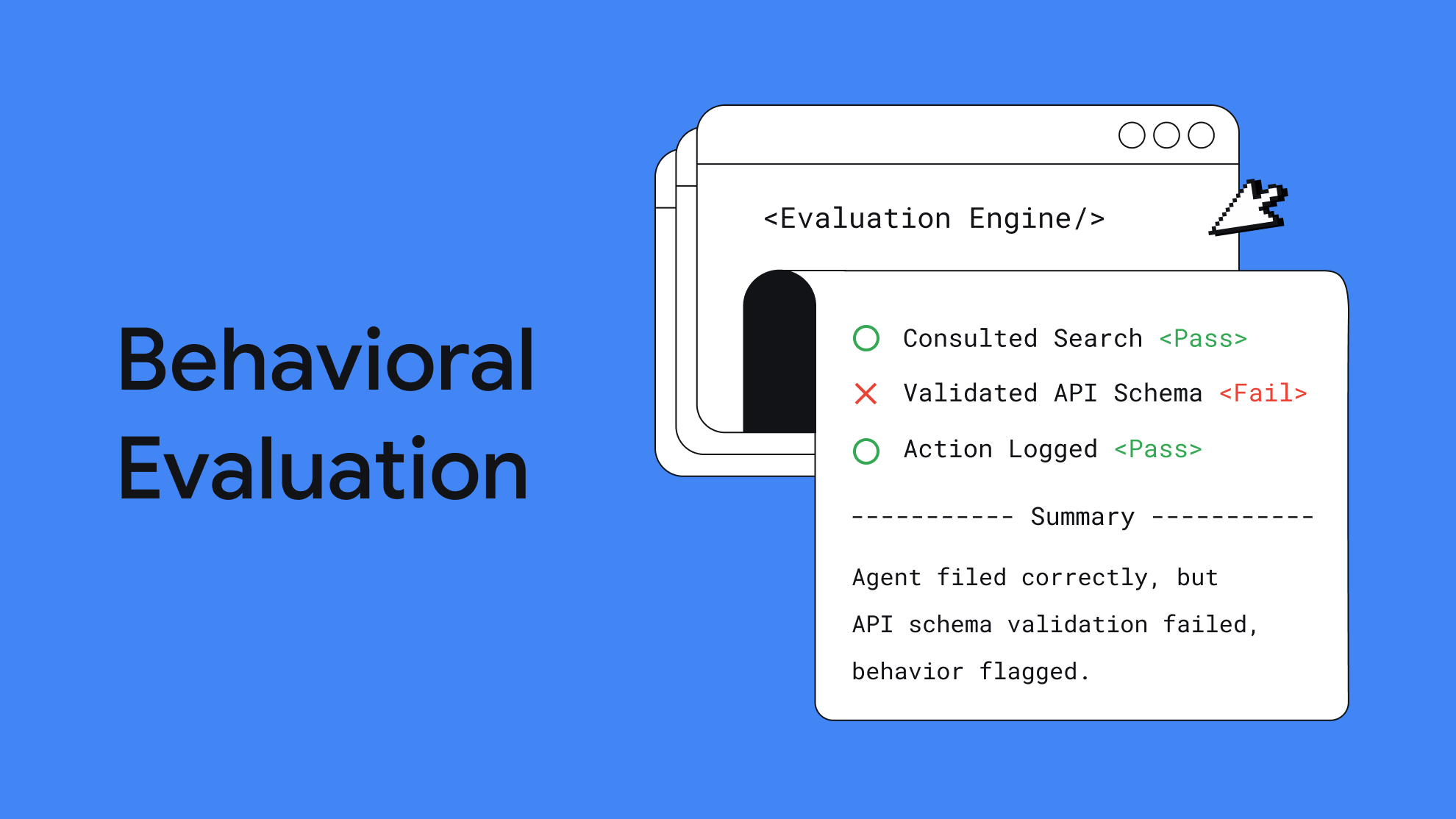
In a post on the Google Developers Blog in September 2026, engineers described a shift in how teams should evaluate AI coding agents. The article argues that relying solely on composite scores from end-to-end benchmarks often leaves developers unable to diagnose why performance changes occur. Instead, it advocates for behavioral evaluations that track specific, observable actions within the agent’s workflow.
What happened
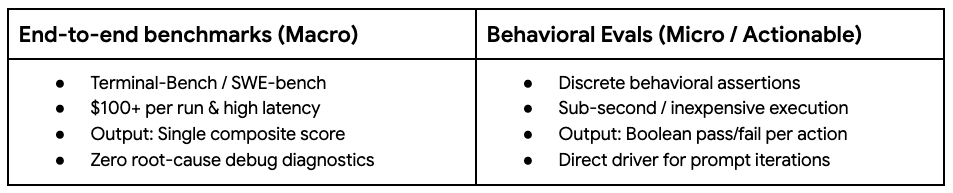
Developers building agentic coding systems frequently encounter a common frustration: they run standard benchmarks like Terminal-Bench or DeepSWE and see their scores fluctuate by small margins. While these end-to-end tests are useful for high-level performance tracking, they do not explain the root cause of regressions or improvements. When a score drops, it remains unclear whether the model became overconfident, forgot to verify test suites, or hallucinated command-line flags. This lack of visibility makes iterative improvement expensive and slow.
The proposed solution is to treat behavioral evaluations as integration tests for the agent harness. Rather than measuring only whether an agent successfully completes a complex multi-file refactor, these evaluations check for discrete steps along the way. For instance, does the agent ask clarifying questions when faced with ambiguous prompts? Does it run a local validator before modifying build files? By focusing on these intermediate behaviors, teams can create a baseline for expected conduct and iterate on prompts with greater confidence.
The article emphasizes that evaluation harnesses should not be the first step in development. Initial phases should rely on developer instinct and dogfooding, where the agent is used to handle boilerplate or routine tasks within its own codebase. Evaluations become critical in the second phase, serving as guardrails against regressions. Their primary role is not to celebrate minor gains but to ensure that changes to prompts, tool schemas, or underlying models do not degrade the agent’s overall reliability.
How it works
A robust behavioral evaluation architecture separates assertions into fast, deterministic checks that run locally. These tests focus on intermediate execution steps, such as specific tool calls or file modifications, rather than final output strings. This approach allows developers to treat the agent harness like standard software, applying unit and integration testing principles to ensure stability during rapid iteration.
For example, using the Antigravity SDK, a test might assert that an agent uses a web search tool when asked about current weather conditions, rather than relying on internal memory. The test checks the list of tool calls made during the interaction, ensuring the correct external resource was consulted. This method provides immediate feedback if a prompt tweak accidentally removes a necessary behavior, acting as a CI/CD-style guardrail.
To build an effective suite, the article suggests starting with a three-step loop. First, identify a single failure mode, such as forgetting to run unit tests. Second, write flexible assertions based on task complexity, using strict checks for simple tasks and outcome-based judgments for complex ones. Finally, automate batch evaluations to monitor stability over time, tracking aggregate pass rates to account for the nondeterministic nature of AI models.
Key details
- End-to-end benchmarks like Terminal-Bench and DeepSWE measure final success but do not explain why performance changes.
- Behavioral evaluations act as integration tests, checking for specific intermediate actions like asking clarifying questions or running validators.
- Development should begin with dogfooding and instinct, introducing formal evaluations only after the agent can handle basic tasks.
- The primary goal of an evaluation suite is to prevent regressions when changing prompts, tools, or models.
- Tests should assert on tool calls and execution steps, not just final text output, using examples from the Antigravity SDK.
- Batch evaluations help manage model nondeterminism by tracking aggregate trends rather than blocking on single noisy runs.
Why it matters
For software engineers and technical leads, this approach reduces the cost of iterating on AI agents. Without behavioral insights, teams waste time guessing why a model’s performance dipped, often leading to blind adjustments that may introduce new errors. By isolating specific behaviors, developers can make targeted changes to system prompts or tool configurations, knowing exactly which capability is being tested. This precision accelerates development cycles and improves the reliability of deployed agents.
Furthermore, treating agent harnesses as standard software components encourages better engineering practices. It moves the field away from viewing models as black boxes that must be coaxed into passing exams, and toward building resilient systems with clear safety nets. This shift is essential as agents take on more complex responsibilities, where unchecked hallucinations or skipped verification steps can have significant consequences in production environments.
What you can do
- Identify one recent failure mode in your agent, such as skipping test runs, and target it for a new behavioral test.
- Write assertions that check for specific tool calls or intermediate steps instead of only validating final output.
- Start with strict single-turn assertions for simple tasks, and use LLM-as-a-judge for complex, multi-path scenarios.
- Automate batch evaluations to track aggregate pass rates over time, smoothing out noise from model nondeterminism.
- Use evaluations primarily as guardrails against regressions when updating prompts or switching models.
- Delay building complex evaluation harnesses until after initial dogfooding proves the agent can handle basic tasks.