Meta opens up AI networking stack at 2026 OCP summit
Meta released details on liquid-cooled switches, open RDMA transport, and multi-tier fabrics supporting its gigawatt-scale Prometheus cluster.
At the 2026 Open Compute Project Global Summit, Meta engineers detailed the networking infrastructure powering their latest AI models and massive compute clusters. The presentations covered hardware innovations like liquid-cooled racks, software-defined fabrics for scaling across data centers, and new open-source initiatives aimed at standardizing the industry.
What happened
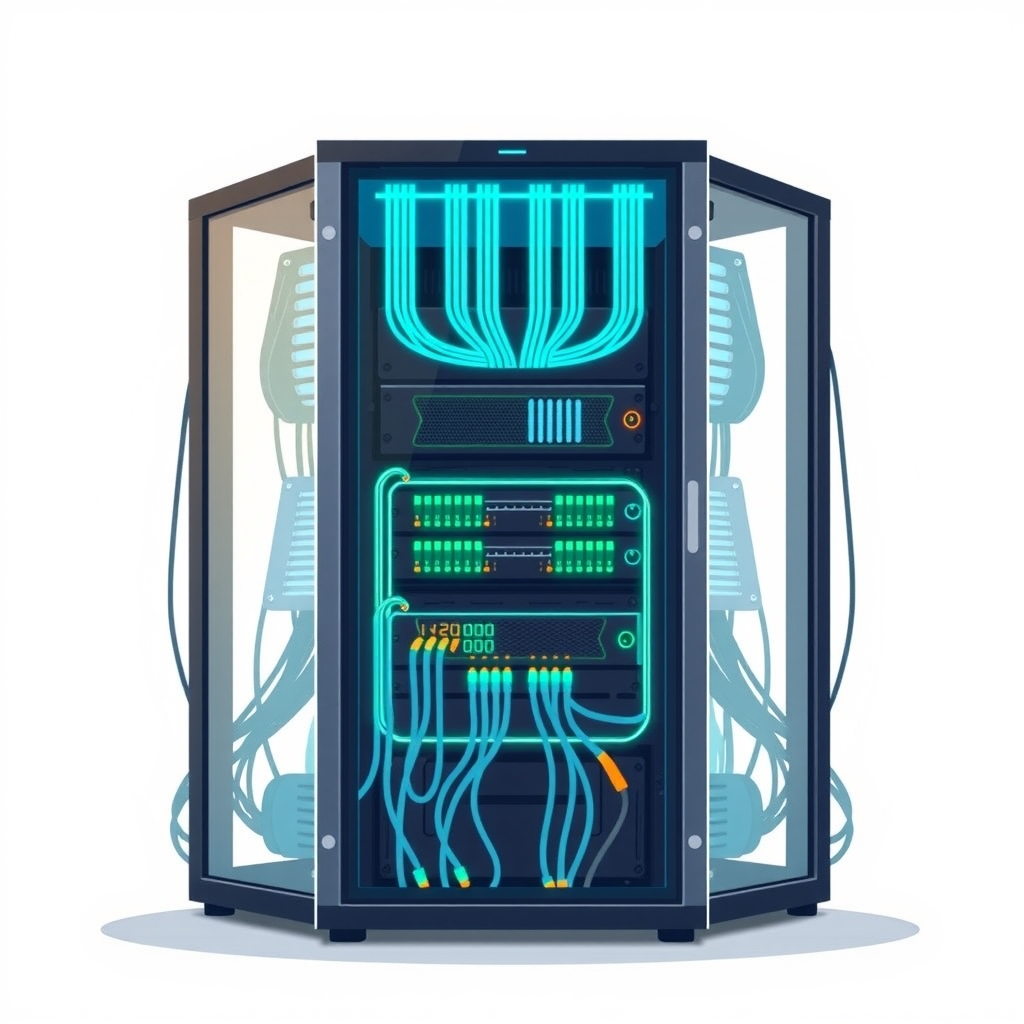
Meta revealed the architecture behind its gigawatt-scale Prometheus cluster, which supports models such as Muse Wonder and Muse Spark. A central focus was the IcePack rack, the company’s first liquid-cooled network enclosure. It houses IceCube switch blades capable of 102.4 terabits per second of throughput. These switches use either Broadcom Tomahawk 6C or NVIDIA Spectrum-6 application-specific integrated circuits and provide 128 ports running at 800 gigabits per second. The system runs on FBOSS, Meta’s open-source network operating system.
The company also described its Flattened Planar Fabric, a design for scaling out GPU clusters. This architecture moves from a traditional three-tier Clos topology to a two-tier model. In this setup, each graphics processing unit connects to eight distinct network planes. The design relies on packet spraying at the network interface card level and a unified control plane that spans both hosts and switches. Meta developed this fabric in collaboration with NVIDIA and shares it with cloud partners.
For connecting infrastructure across buildings and regions, Meta introduced Backend Aggregation, or BAG. This petabit-scale super-spine links different parts of the Prometheus cluster. The regional backbones use Segment Routing over IPv6 running on FBOSS and the Switch Abstraction Interface. To handle communication within racks, Meta showcased Tahan, an Ethernet-based scale-up switch built on Broadcom Tomahawk5 silicon for its MTIA 300 accelerators. The company also previewed a configuration supporting 72 accelerators per rack using 102.4T silicon.
How it works
The shift to liquid cooling in the IcePack rack addresses the thermal density of high-speed switches. By removing air-cooling constraints, Meta can pack more bandwidth into a smaller footprint. The IceCube switches use a hybrid liquid and air-cooled design without physical layer chips, relying instead on advanced optics. This approach reduces power consumption and heat generation, which are critical bottlenecks at this scale. The network uses active electrical cables for short-reach links to manage costs and reliability.
On the software side, Meta is opening up its remote direct memory access transport, called MetaRoCE. This protocol handles data movement between GPUs during training tasks like all-reduce and all-to-all operations. By making the software open source, starting with a user-space library on GitHub, Meta aims to improve interoperability and performance across different hardware vendors. The transport is designed to prevent the slowest node from gating the entire cluster, a common issue in large-scale distributed training.
To reduce fragmentation in switch platform development, Meta co-leads the Open Switch Platform Architecture initiative with Microsoft and Alibaba. This effort provides a unified reference design for the switch platform layer, sitting above the data plane software. The goal is to eliminate months of duplicated work when bringing up new hardware platforms. The version 1.0 specification has been submitted to the Open Compute Project.
Key details
- IcePack racks use 102.4T switch blades with 128x800G capacity and run on FBOSS.
- The Flattened Planar Fabric connects each GPU to eight network planes in a two-tier topology.
- Backend Aggregation serves as a petabit-scale super-spine for cross-region connectivity.
- Tahan switches support MTIA 300 accelerators using Broadcom Tomahawk5 silicon.
- MetaRoCE RDMA transport is being released as open-source software on GitHub.
- The Open Switch Platform Architecture v1.0 spec aims to standardize switch platform layers.
Why it matters
For engineers building large-scale AI systems, these developments highlight the increasing importance of network efficiency. As model sizes grow, the time spent communicating between GPUs often exceeds computation time. Meta’s move to open-source its transport layer and define standard platform architectures reduces the barrier to entry for high-performance networking. It allows teams to adopt proven designs rather than building proprietary solutions from scratch.
The emphasis on liquid cooling and high-density optics also signals a shift in data center design. Traditional air-cooled racks cannot support the power densities required for next-generation switches. Engineers must now consider thermal management as a core part of network architecture. The availability of detailed validation methodologies for copper interconnects and optics provides practical guidance for handling yield and reliability issues at scale.
What you can do
- Review the open-source MetaRoCE libraries on GitHub to understand modern RDMA transport implementations.
- Study the Open Switch Platform Architecture specification to streamline hardware bring-up processes.
- Evaluate liquid-cooling requirements for high-density network deployments in your infrastructure plans.
- Analyze the Flattened Planar Fabric design principles for optimizing GPU-to-network connectivity.
- Watch the recorded sessions from the 2026 OCP Global Summit for deep dives into specific components.
- Consider adopting active electrical cables for short-reach links to balance cost and performance.