Cutting robot agent latency by pipelining thought and motion
Engineers reduced real-world robot task times from 18 minutes to 6 by optimizing the agent harness, using persistent kernels and pipelined execution to hide model latency behind physical motion.
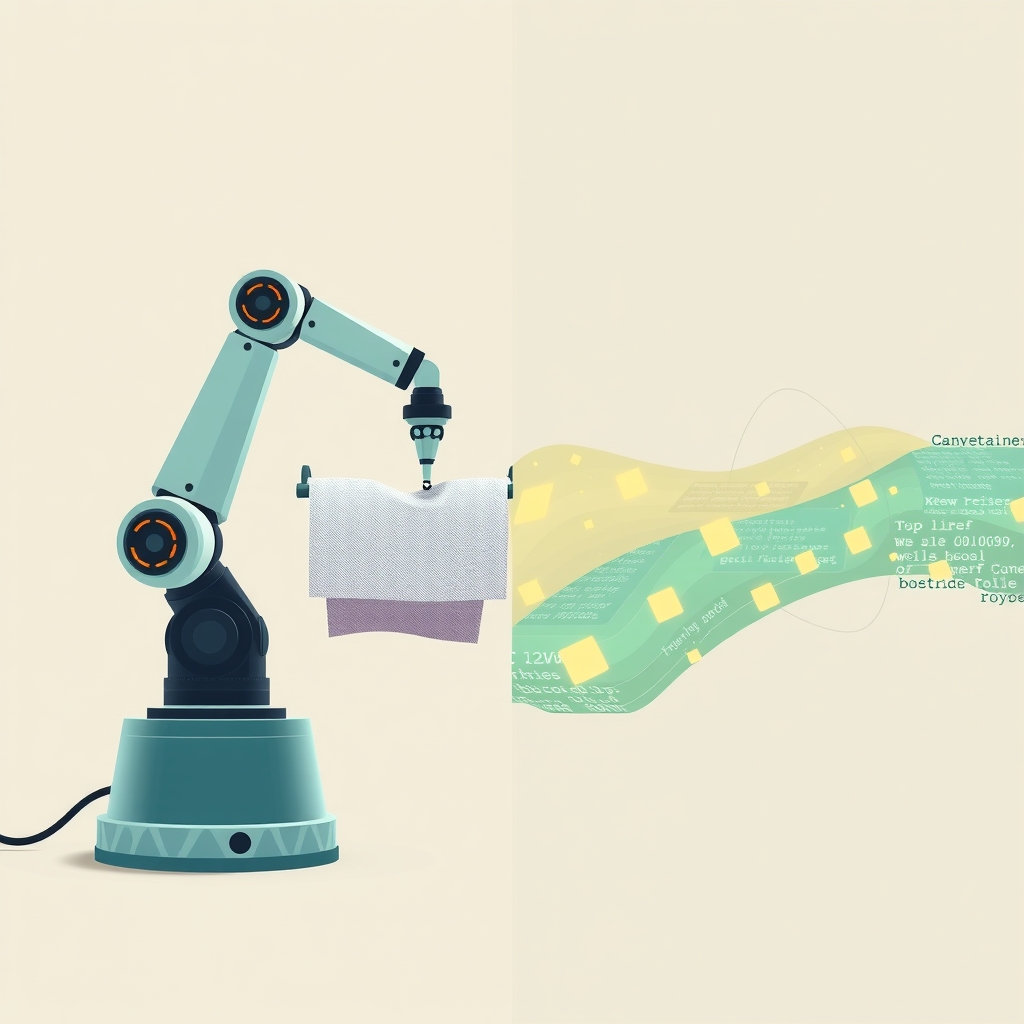
Robot-use agents have achieved impressive scores in simulation benchmarks, yet they remain impractically slow when deployed on physical hardware. A recent technical deep dive reveals that while models like GPT-6 Astra can outperform traditional policies in simulated environments, real-world execution is bottlenecked by the time the robot spends idle waiting for the model to generate code. By re-engineering the software harness rather than the model itself, researchers reduced the median time for a towel-folding task from 18 minutes to just six minutes.
What happened
The core issue lies in how standard benchmarks evaluate robotic performance. Simulators like RoboDojo use a synchronous evaluation loop where the simulation clock pauses until the policy returns its next action. In this setup, the time it takes for a large language model to process input and generate output, known as time to first token (TTFT), is effectively invisible. The benchmark measures success by the number of steps taken, not the wall-clock time elapsed. Consequently, agents that are computationally expensive but logically sound appear highly efficient in simulation, even if they would cause a real robot to stand still for long periods between movements.
When these same agents are deployed on physical hardware, the clock never stops. The robot remains stationary while the model processes visual data, reasons about the next step, and generates Python code to execute. In one observed case, a robot solving a puzzle cube took approximately an hour, even after editing out video pauses. This latency gap renders many state-of-the-art agents unusable for tasks requiring timely interaction with the physical world. The researchers focused on closing this gap by optimizing the infrastructure surrounding the model, specifically the tools, context management, and execution scheduling.
The team used a two-arm robot setup with four cameras and GPT-6 Astra running via an API. They did not alter the underlying model architecture or training. Instead, they modified the harness—the code that connects the model to the robot. By treating the model as a black box and focusing on how requests were structured and executed, they significantly reduced idle time. The result was a system where the robot was in motion 84% of the time during a cup-handling task, compared to frequent long pauses in previous implementations.
How it works
The primary optimization involved reducing the number of round trips between the agent and the robot server. In typical setups, every tool call incurs overhead from network latency and model processing. The researchers minimized this by using a persistent Python kernel. Instead of starting a new process for every command, the agent runs code in a long-lived environment where imports are paid for only once. Variables and helper functions persist across calls, allowing the model to write short, efficient scripts that leverage previously defined logic. This approach cuts the startup time for each action from hundreds of milliseconds to tens of milliseconds.
Further efficiency gains came from pipelining thinking and motion. In a non-pipelined system, the robot waits for the model to finish planning before moving. In the optimized harness, the robot begins executing the current action while the model simultaneously plans the next one. The system uses a queue mechanism where actions are scheduled in the background. As the robot performs a movement, the model receives feedback from the previous step and generates the subsequent command. If the model finishes early, it can revise upcoming actions; if it is slow, the robot continues moving based on the last valid plan. This hides most of the model's inference latency behind the physical duration of the robot's movements.
Key details
- The median time for a towel-folding task dropped from approximately 18 minutes to 6 minutes after optimizing the harness.
- During a cup-handling task, the robot was in motion 84% of the time, significantly reducing idle periods.
- The system still experiences a latency lag where the robot acts on visual data that is about 5 seconds old.
- Benchmarks like RoboDojo do not reflect real-world latency because they pause the simulation clock during model inference.
- The agent uses GPT-6 Astra at the ultrafast service tier with medium reasoning effort, accessed via an API.
- Code and tools for the optimized harness, including a small simulator, are available on GitHub under the fast-rua repository.
Why it matters
For engineers building embodied AI systems, this work highlights a critical distinction between logical correctness and temporal efficiency. A model may generate perfect code for a task, but if the generation process takes too long, the physical opportunity to execute that code may pass. This is particularly relevant for dynamic environments where objects move or conditions change rapidly. Understanding that latency is primarily a harness engineering problem, rather than solely a model speed issue, allows teams to focus on architectural optimizations that yield immediate real-world improvements without waiting for faster foundational models.
The shift toward pipelined execution also changes how developers should design agent loops. Traditional request-response patterns are insufficient for real-time robotics. Systems must be designed to decouple perception, planning, and execution, allowing them to overlap. This requires robust state management and safety mechanisms, such as the workspace fences and distance checks implemented in the robot server, to ensure that asynchronous actions do not lead to collisions or errors. As robot-use agents become more common, these harness-level optimizations will be essential for making them viable in production settings.
What you can do
- Audit your agent harness to identify unnecessary round trips between the model and external tools.
- Implement persistent execution environments for code-generating agents to avoid repeated import and startup costs.
- Design action queues that allow physical execution to proceed while the model plans subsequent steps.
- Measure wall-clock time in addition to step counts when evaluating robotic agents to capture true latency.
- Use white-box tool APIs that allow the model to read source code and generate helper functions dynamically.
- Test agents in real-time simulators that do not pause during inference to better predict physical deployment performance.