Running DeepSeek-V4.1-Flash on four consumer AMD GPUs at API-level cost
A local inference setup using four Radeon RX 9070 XTs processes 500 BIRD benchmark questions simultaneously, matching cloud API accuracy while reducing energy costs significantly.
On November 17, 2026, engineer Alexander Selzer demonstrated that a custom local server equipped with four consumer-grade AMD graphics cards can run the massive DeepSeek-V4.1-Flash model efficiently. By processing 500 text-to-SQL queries in a single large batch, the system achieved generation speeds and accuracy comparable to commercial cloud APIs, but at a fraction of the operational energy cost.
What happened
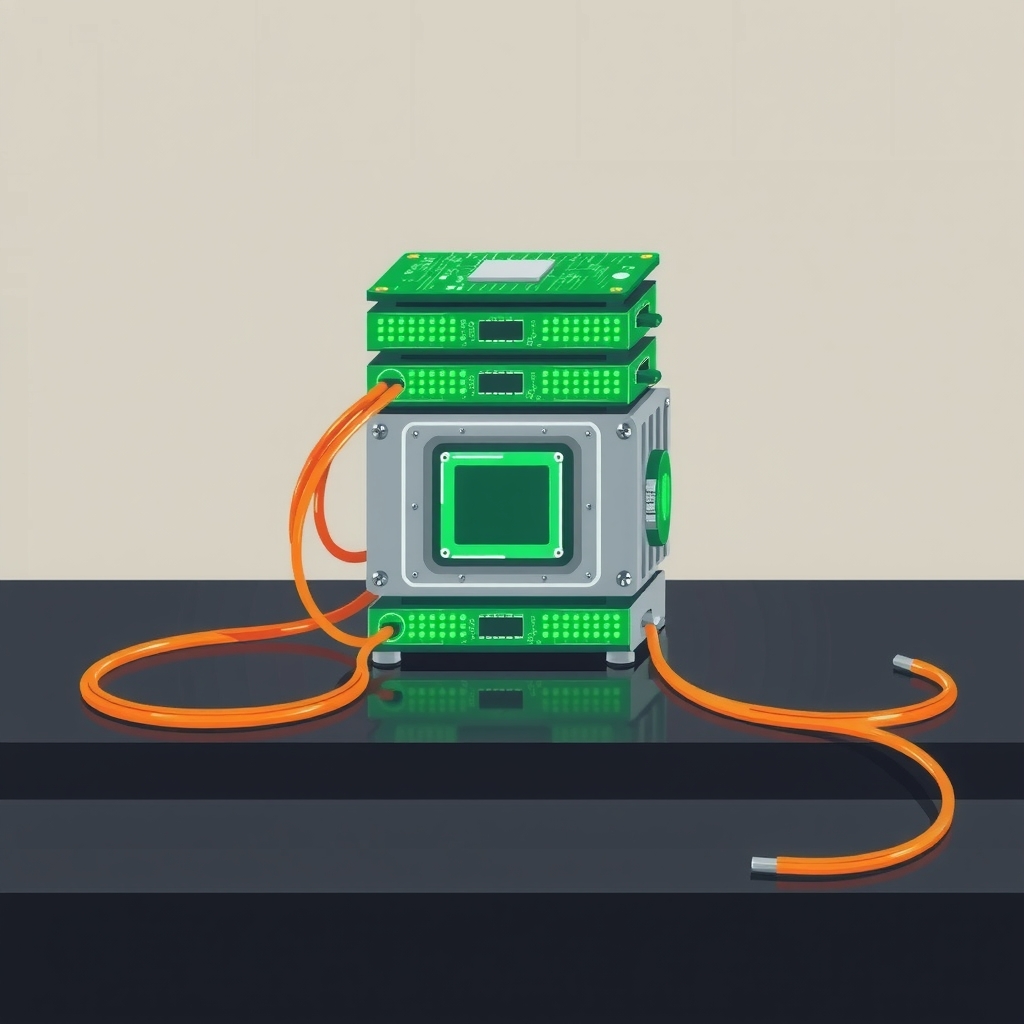
Selzer configured a workstation featuring four Radeon RX 9070 XT GPUs, each with 16 GB of VRAM, connected to an AMD EPYC CPU and 256 GB of system RAM. The goal was to test whether this hardware could handle DeepSeek-V4.1-Flash, a model whose full precision weights occupy 416 GB, far exceeding the 64 GB of total video memory available. Using a modified version of the Radiance inference engine, the system streamed model experts from RAM and storage as needed, allowing it to process the entire 500-question BIRD text-to-SQL benchmark in one go.
The results showed that batch size dramatically influences efficiency. While processing a single request yielded only 25 to 35 tokens per second, increasing the batch to 500 simultaneous requests boosted generation speed to 228 tokens per second. The entire job completed in 3.5 minutes for the original BIRD set and 39 minutes for the more complex 2026 revision, which requires step-by-step reasoning. Crucially, the accuracy of the local model matched or slightly exceeded that of major API providers like DeepInfra and Wafer, while the electricity cost for the job was roughly equivalent to the API fees.
How it works
The core challenge is fitting a 416 GB model onto hardware with limited fast memory. The solution relies on Mixture of Experts (MoE) architecture, where only a small subset of the model’s parameters is active for any given token. Selzer’s setup uses a caching strategy that keeps the most frequently used experts in the 256 GB of system RAM, while less common experts are read from a fast NVMe SSD. This approach leverages the high bandwidth of the CPU’s memory channels and the PCIe links to feed data to the GPUs without stalling computation.
To maximize throughput, the system employs batched expert passes. Instead of handling experts individually for each token, the engine groups tokens that require the same expert and processes them together. This reduces the number of times data must be copied across the PCIe bus. Additionally, the CPU assists the GPUs by computing some expert layers directly from RAM, utilizing otherwise idle memory bandwidth. The combination of these techniques allows the four GPUs to operate near their theoretical limits when handling large batches, turning a memory-bound problem into a compute-bound one.
Key details
- Hardware: Four Radeon RX 9070 XT (16 GB each), AMD EPYC 7443 CPU, 256 GB DDR4 RAM, and Samsung 990 PRO SSD.
- Performance: 228 tokens/s generation speed for 500 concurrent requests on the original BIRD benchmark.
- Accuracy: 61.8% on original BIRD and 50.6% on BIRD 2026, matching or beating cloud API results.
- Cost Efficiency: Electricity cost for the 500-query job was approximately €0.13, comparable to API pricing.
- Energy Use: Power consumption ranged from 520 W to 700 W, with large batches using six to ten times less energy per token than single requests.
- Software: Modified Radiance inference engine with custom expert caching and batched kernel optimizations.
Why it matters
For developers building AI applications, this demonstration proves that high-quality inference does not strictly require expensive cloud infrastructure or enterprise-grade hardware. By optimizing for large batches, local setups can achieve cost parity with cloud providers while offering greater control over data privacy and model behavior. This is particularly relevant for tasks like text-to-SQL generation, where accuracy is critical and data sensitivity may preclude sending queries to third-party APIs.
The results also highlight the importance of software optimization in unlocking hardware potential. The gap between single-request and batched performance shows that naive deployment strategies leave significant capacity unused. Engineers who invest in understanding batching, memory management, and expert placement can drastically reduce their operational costs. This approach makes it feasible to run state-of-the-art models on commodity hardware, democratizing access to advanced AI capabilities for smaller teams and individual developers.
What you can do
- Evaluate your workload for batching opportunities, especially if you handle many similar short requests.
- Consider AMD GPUs with high memory bandwidth if you plan to run large MoE models locally.
- Use system RAM as a cache for model experts that do not fit in VRAM, prioritizing frequently used components.
- Profile your specific use case to identify which experts are most active, allowing for smarter memory allocation.
- Test reproducibility modes in your inference engine to ensure consistent outputs when using mixed CPU-GPU computation.
- Monitor power consumption per token to optimize batch sizes for energy efficiency, not just speed.