NVIDIA releases open-source tools for managed GPU Kubernetes clusters
NVIDIA introduces NVKE and NVKR, two open-source projects that help AI factories build and operate managed Kubernetes services on GPU infrastructure.
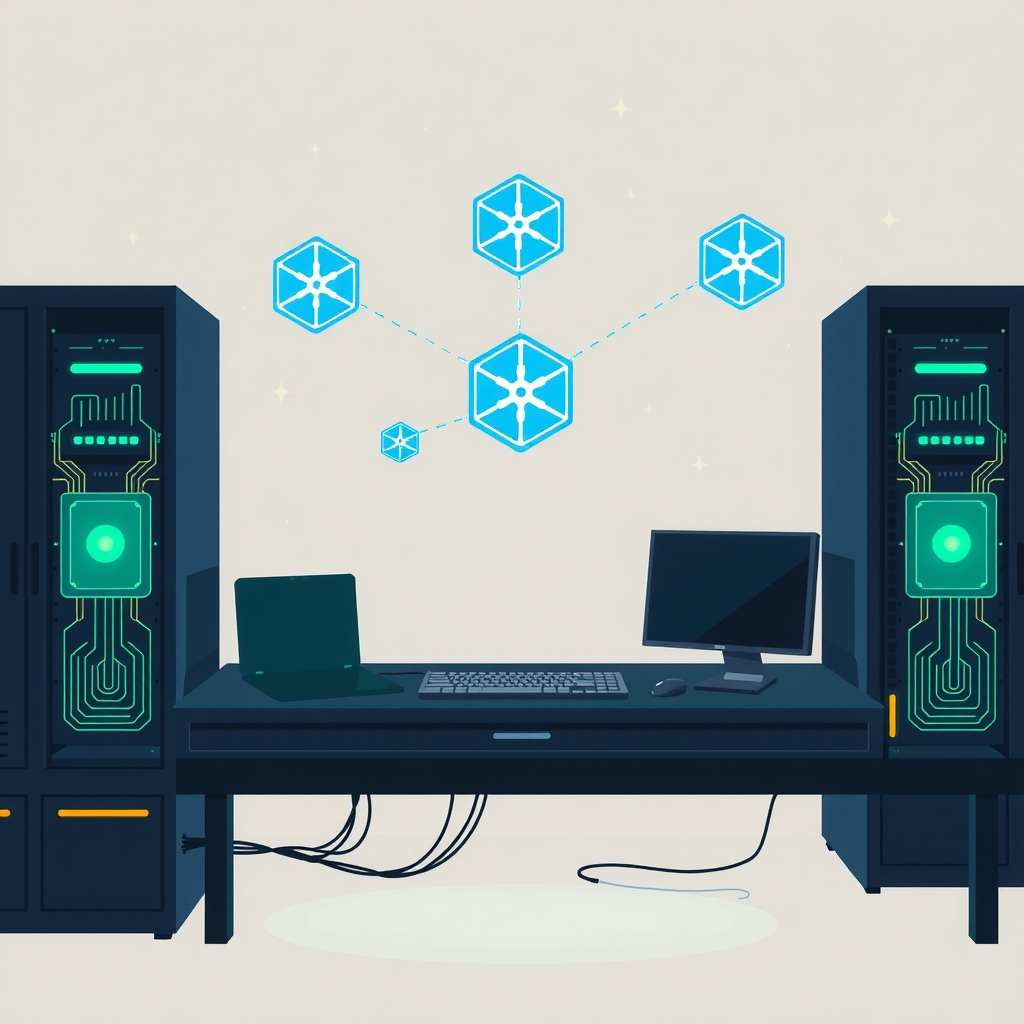
NVIDIA has released two new open-source projects, NVIDIA Kubernetes Engine (NVKE) and NVIDIA Kubernetes Recipes (NVKR), designed to help organizations build and operate managed Kubernetes services on GPU infrastructure. Announced on November 10, 2026, these tools are part of the NVIDIA DSX AI Factory Platform and are currently available in public preview under the Apache 2.0 license.
What happened
The release addresses a growing need for AI factories to provide GPU capacity through standard Kubernetes APIs while maintaining strict operational control. Building such a service requires complex API-driven provisioning, tenant isolation, and rigorous qualification of GPU hardware, networking, and drivers across different generations. NVKE and NVKR split this workload into two distinct areas: cluster management and reproducible software builds.
NVKE provides the software layer for running a managed Kubernetes service directly on the factory’s infrastructure. It exposes APIs that allow operators to provision and manage clusters programmatically. NVKR complements this by building the necessary operating system images, container images, and packages. It uses recipes to define validated combinations of software versions and GPU generations, ensuring consistency and reproducibility.
Several major industry players are already integrating these tools. NVIDIA Cloud Partners Firmus and SK Telecom are incorporating NVKE and NVKR into their AI factories. Additionally, partners including Mirantis, Rafay, Spectro Cloud, OpenNebula Systems, vCluster, and Netris are adopting components to enhance their managed Kubernetes and network automation offerings.
How it works
NVKR acts as the build engine, producing node images, binaries, and Helm charts from specific, version-pinned sources. It records every input used in the build process, allowing teams to identify exactly what software is included in each image and rebuild it later if needed. This ensures that the management cluster and node pools can run different images tailored to specific CPU architectures or GPU generations.
NVKE handles the lifecycle management of the clusters using the artifacts produced by NVKR. The management plane is deployed using a command-line tool called nvkectl. This tool bootstraps a temporary seed cluster on a host machine, which then requests servers from the NVIDIA Infra Controller (NICo) via CAPNICo, the Cluster API infrastructure provider for NICo. Once the servers are provisioned and joined, the temporary cluster is deleted, leaving behind a permanent management cluster.
This management cluster runs the REST API and controllers that create customer workload clusters. Each workload cluster has its own independent Kubernetes control plane, etcd database, and node pools. Security is enforced through SPIFFE identities, where nodes must present an attested identity before receiving join credentials. Telemetry is handled via an OpenTelemetry-based pipeline that exports logs, metrics, and traces to a monitoring backend.
Key details
- License and status: Both projects are open source under the Apache 2.0 license and are in public preview, meaning APIs and behavior may change and they are not yet recommended for production workloads.
- Decoupled architecture: NVKE has no runtime dependency on NVKR, and NVKR can build artifacts for other Kubernetes management systems, allowing teams to adopt them independently.
- Conformance: NVKE is a Certified Kubernetes AI Platform and Certified Kubernetes Installer, with conformance testing performed on Kubernetes 1.36.
- Build process: NVKR builds node images from version-pinned sources, compiling agents and staging packages like OVN-Kubernetes and SPIRE into QCOW2 disk images.
- Provisioning flow: The
nvkectltool manages the entire lifecycle, from bootstrapping the management cluster to creating customer clusters with specific instance types and VPC configurations. - Partner ecosystem: Integration is underway with major cloud partners and Kubernetes management vendors, including Firmus, SK Telecom, Mirantis, and Rafay.
Why it matters
For infrastructure leads and technical founders building AI products, managing GPU clusters at scale is a significant operational burden. Traditionally, qualifying hardware and software stacks across different GPU generations and Kubernetes versions requires extensive manual effort. NVKR automates this by providing reproducible builds, reducing the risk of configuration drift and ensuring that every node runs a validated software stack. This allows engineering teams to focus on application development rather than infrastructure maintenance.
Furthermore, the ability to offer managed Kubernetes services with strong tenant isolation and API-driven provisioning is critical for AI factories that want to monetize their GPU capacity. NVKE provides the necessary control plane to manage multiple customer clusters securely and efficiently. By open-sourcing these tools, NVIDIA enables a broader ecosystem of providers to build compatible services, potentially lowering the barrier to entry for organizations looking to deploy large-scale AI infrastructure.
What you can do
- Review the NVKE and NVKR documentation on GitHub to understand the architecture and deployment requirements.
- Try the local quickstart guide, which allows you to evaluate NVKE on a single machine without needing GPU infrastructure or an NVIDIA account.
- Join the NVIDIA DSX AI Factory Slack workspace, specifically the
#nvkechannel, to discuss implementation details with the community. - Examine the public roadmaps for both projects to see planned features and upcoming changes during the preview period.
- If you are a partner or provider, explore how to integrate NVKE components into your existing managed Kubernetes or network automation offerings.
- Provide feedback and contributions to the GitHub repositories to help shape the future development of the DSX AI Factory stack.