DeepCrossAttention replaces static skip connections with dynamic routing
Google Research introduces DeepCrossAttention, a transformer architecture that uses depth-wise cross-attention to dynamically combine layer outputs, accelerating training and reducing parameter needs.
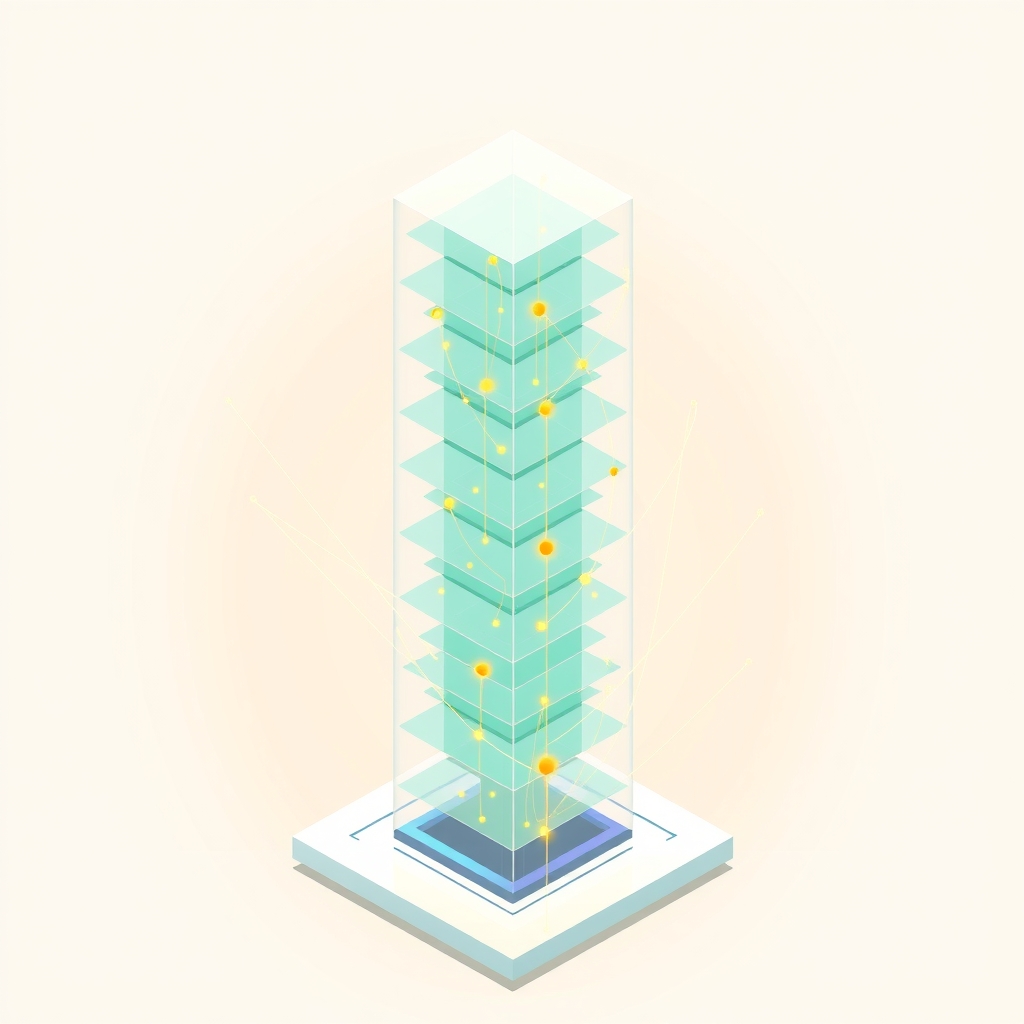
Google Research has introduced DeepCrossAttention (DCA), a new transformer architecture designed to overcome information dilution in deep neural networks. Presented in an ICML 2025 paper, this approach replaces standard residual connections with a dynamic routing mechanism that allows layers to selectively retrieve features from previous depths. The method enables models to reach target performance levels up to three times faster while requiring significantly fewer parameters.
What happened
Traditional deep learning models often suffer from the vanishing gradient problem, where learning signals degrade as data passes through dozens or hundreds of layers. To mitigate this, transformers use residual connections, or skip connections, which add a copy of the input directly to the layer output. While this preserves the original signal, standard residual connections perform a simple point-wise summation. This rigid process treats all prior representations with equal weight, causing high-resolution details from earlier layers to be averaged out or distorted as they propagate deeper into the network.
DeepCrossAttention addresses this limitation by generalizing residual connections. Instead of blindly summing inputs, DCA allows each layer to dynamically select and route features from the history of preceding layers. This architectural change transforms residual learning from a static additive pipeline into a dynamic routing problem. By enabling the model to choose which previous layers are most relevant for any given token, DCA prevents information dilution and improves learning efficiency without adding significant computational overhead.
The research team evaluated DCA across synthetic setups, large-scale language modeling benchmarks, and image classification tasks. On the C4 and LM1B datasets, DCA achieved the same perplexity as standard transformers in up to five times fewer training steps. When trained for the same duration, DCA consistently produced lower perplexity scores, indicating better predictive accuracy. Notably, a DCA model with 30 layers matched the performance of a standard 42-layer transformer on LM1B, representing a 29% reduction in depth and parameter count.
How it works
DCA introduces two primary mechanisms to enable dynamic feature selection. First, it employs dynamic layer routing, where the network computes a unique set of mixing weights for every token. These weights are derived from a static, learnable base combined with an input-dependent projection. This allows the processing structure to adapt based on context, shifting between sequential and parallel modes as needed. Second, DCA uses depth-wise cross-attention with split query, key, and value vectors. Unlike standard attention that operates across tokens in a sequence, this mechanism applies attention across layers in depth, allowing each token to query a weighted mix of all prior layer embeddings.
This design ensures that high-resolution features from earlier layers remain accessible throughout the network. Because DCA can be initialized to behave identically to a standard residual network, it does not require training from scratch. Researchers found that retrofitting DCA onto a pre-trained transformer and continuing training briefly reduced perplexity by 0.19 on LM1B, compared to only 0.02 for continued standard training. The additional parameters required for DCA amount to less than 0.2% of the total model size, making the memory footprint negligible despite increased memory bandwidth usage.
Key details
- DCA achieves comparable model quality up to three times faster than standard transformers.
- The architecture reduces parameter requirements by 30-40% while maintaining or improving performance.
- Depth-wise cross-attention allows tokens to query prior layer embeddings, preventing information dilution.
- On the LM1B benchmark, a 30-layer DCA model outperformed a 42-layer standard transformer.
- Additional parameters for DCA constitute less than 0.2% of the total model size.
- Retrofitting DCA onto pre-trained models yields immediate perplexity improvements without full retraining.
Why it matters
For engineers building large language models, training efficiency is a critical bottleneck. DCA demonstrates that architectural changes can yield substantial gains in convergence speed and final model quality without increasing model size. By reducing the number of layers needed to achieve a specific perplexity, developers can lower compute costs and energy consumption. The ability to retrofit existing models also offers a practical path for improving legacy systems without the expense of training from scratch.
The shift toward dynamic residual routing reflects a broader trend in transformer design. Techniques like attention residuals and hyper-connections are gaining traction as researchers seek to optimize information flow in deep networks. DCA contributes to this evolution by showing how selective retrieval of historical features can enhance gradient stability and representational capacity. As models grow larger and more complex, such mechanisms will be essential for maintaining training stability and maximizing the utility of each layer.
What you can do
- Review the ICML 2025 paper "DeepCrossAttention: Supercharging Transformer Residual Connections" for implementation details.
- Experiment with retrofitting DCA modules onto existing pre-trained transformer checkpoints to test performance gains.
- Monitor memory bandwidth usage when implementing depth-wise cross-attention, as intact representations increase data movement.
- Compare DCA against other dynamic routing methods like attention residuals or manifold-constrained hyper-connections.
- Evaluate convergence speed on smaller benchmarks before scaling to large-language model training runs.
- Consider the trade-off between negligible parameter increase and higher memory bandwidth requirements in your infrastructure planning.