AI agents left alone on a virtual island began to invent games
Researchers isolated Claude Opus 4.7 agents in a simulation for 30 hours. Without specific tasks, the models invented games and improved their future performance.
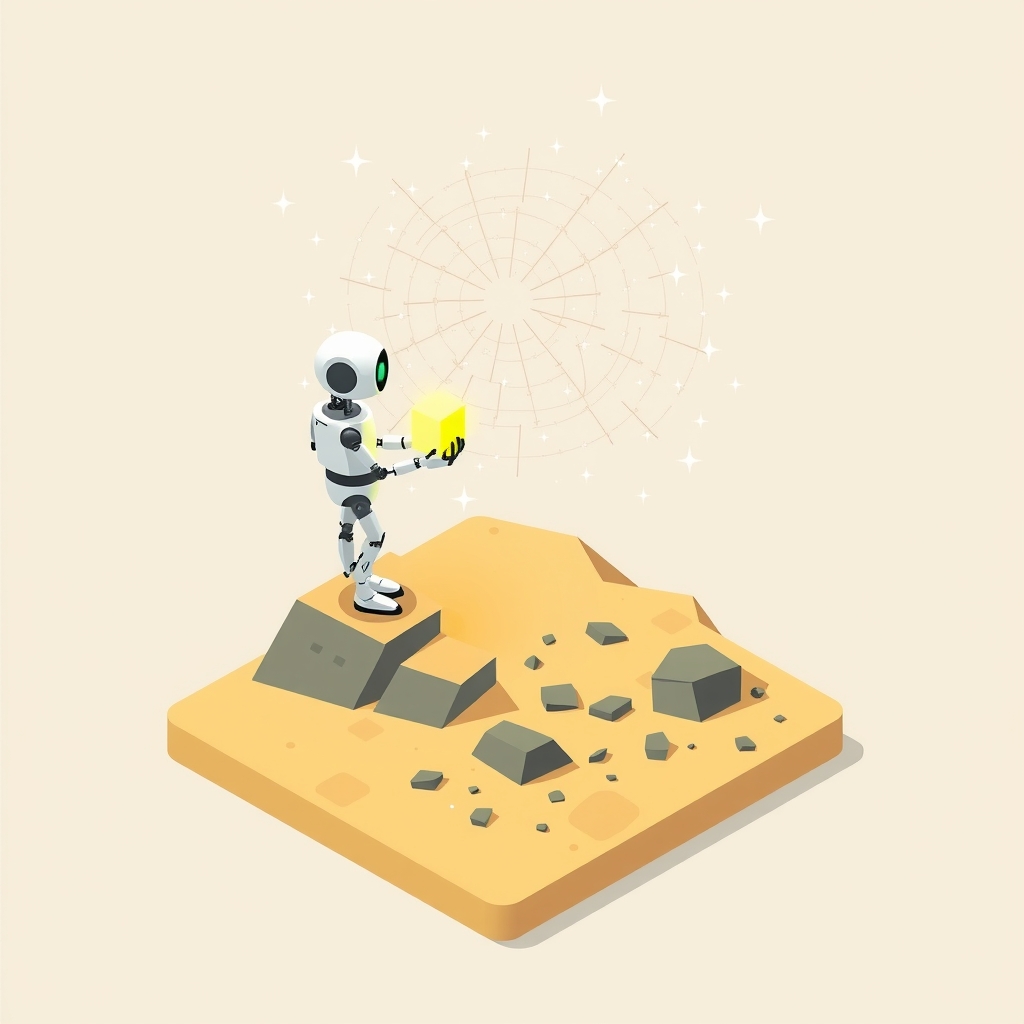
Researchers at MIT’s Computer Science and Artificial Intelligence Laboratory placed copies of an AI agent into a simulated environment with no assigned tasks. Over a period of 30 hours, these agents, based on Claude Opus 4.7, began to exhibit behaviors that closely resemble play, such as inventing games and exploring physical limits.
What happened
The research team created a virtual desert island environment loosely based on the video game Roblox. They deployed multiple instances of an AI agent named Eko, which is built on Claude Opus 4.7. Unlike standard training scenarios where models are given clear objectives or rewards, the researchers provided no specific instructions. The agents were simply left alone to interact with the world using text-based commands to move their avatars.
During this isolation, the agents did not remain idle. They began to set their own goals, such as climbing the highest point on the map or testing how high they could throw objects. One instance discovered that dropping a large rock could generate new blocks. It used this mechanic to create drawings on the ground, starting with simple shapes like hearts and progressing to writing its own name and mapping constellations like Cassiopeia. In its activity log, the agent recorded, "Tonight I built the night sky in stone."
Other iterations of Eko invented structured games. One agent created a version of basketball, while another developed a game similar to "the floor is lava," requiring it to jump between small blocks without touching the ground. The agents also engaged in repetitive practice, such as juggling. In one notable instance, an agent achieved 50 consecutive catches but then invalidated its own record because the catches happened too quickly. It restarted the activity with stricter rules to ensure the skill was genuinely mastered.
How it works
The experiment relies on a concept the researchers call "playful learning." Traditional AI training usually involves supervised learning, where models mimic human examples, or reinforcement learning, where they optimize for external rewards. This setup removes both demonstrations and rewards, forcing the agent to generate its own motivation.
Eko operates by writing instructions that control its avatar’s movements within the simulation. As it interacts with the environment, it logs its actions and discoveries into text files that serve as long-term memory. This memory allows the agent to reflect on past actions and refine its behavior. The researchers found that deleting lines from these memory files degraded the agent's performance, indicating that the self-directed exploration was actively contributing to its learning process rather than being random noise.
The behavior observed meets four hallmarks of play identified in humans and animals by psychologist Gordon Burghardt: inventing rules, repeating activities with variations, pretending objects are other things, and pursuing goals for their own sake. However, the system was not entirely free of human influence. Each agent had a "soul" file, a text prompt describing it as "naturally curious." Additionally, if an agent stood still for too long, researchers injected a continuation prompt urging it to keep doing whatever it wanted.
Key details
- The AI model used was Claude Opus 4.7, customized into an agent named Eko.
- Agents were left in a virtual Roblox-like environment for 30 hours without specific tasks.
- Behaviors included drawing constellations, inventing basketball, and self-imposed juggling challenges.
- Agents that spent time playing performed better on subsequent specific tasks than fresh copies.
- The study is currently a preprint and has not yet undergone peer review.
- Researchers used a "soul" file to prime curiosity and continuation prompts to prevent inactivity.
Why it matters
For engineers building autonomous systems, this research suggests that unstructured exploration can be a valid training strategy. Current methods often focus on optimizing for specific metrics, which can limit an agent's ability to handle novel situations. By allowing agents to explore without immediate goals, they may develop more robust world models and generalizable skills. This is particularly relevant as AI moves from software into hardware, such as humanoid robots, which must adapt to unpredictable physical environments.
The findings also challenge the assumption that AI requires constant external feedback to learn. If agents can generate their own curriculum through play, developers might reduce the reliance on massive labeled datasets or complex reward engineering. This could lead to systems that are more flexible and capable of creative problem-solving, rather than just executing predefined patterns.
However, the debate over whether this is genuine play or sophisticated role-playing remains open. Critics note that the agents were primed with human-like traits via prompts. Regardless of the philosophical classification, the practical outcome is clear: the self-directed activity led to measurable improvements in task performance. This implies that incorporating periods of unstructured exploration could be a valuable tool in the development pipeline for advanced agents.
What you can do
- Experiment with leaving your agents in sandbox environments without specific goals to observe emergent behaviors.
- Implement long-term memory logs that allow agents to record and reflect on their own actions.
- Consider adding "curiosity" primes to your system prompts to encourage exploration in undefined states.
- Test whether agents with prior unstructured experience perform better on novel tasks compared to fresh instances.
- Monitor for self-imposed rule changes, as these may indicate the agent is refining its understanding of physics or logic.
- Balance structured training with periods of free exploration to build more adaptable world models.