Hugging Face releases LFM3, a 2B-parameter multimodal model family for edge devices
Hugging Face introduces LFM3, a new generation of open-weight models optimized for on-device deployment across text, vision, and audio modalities.
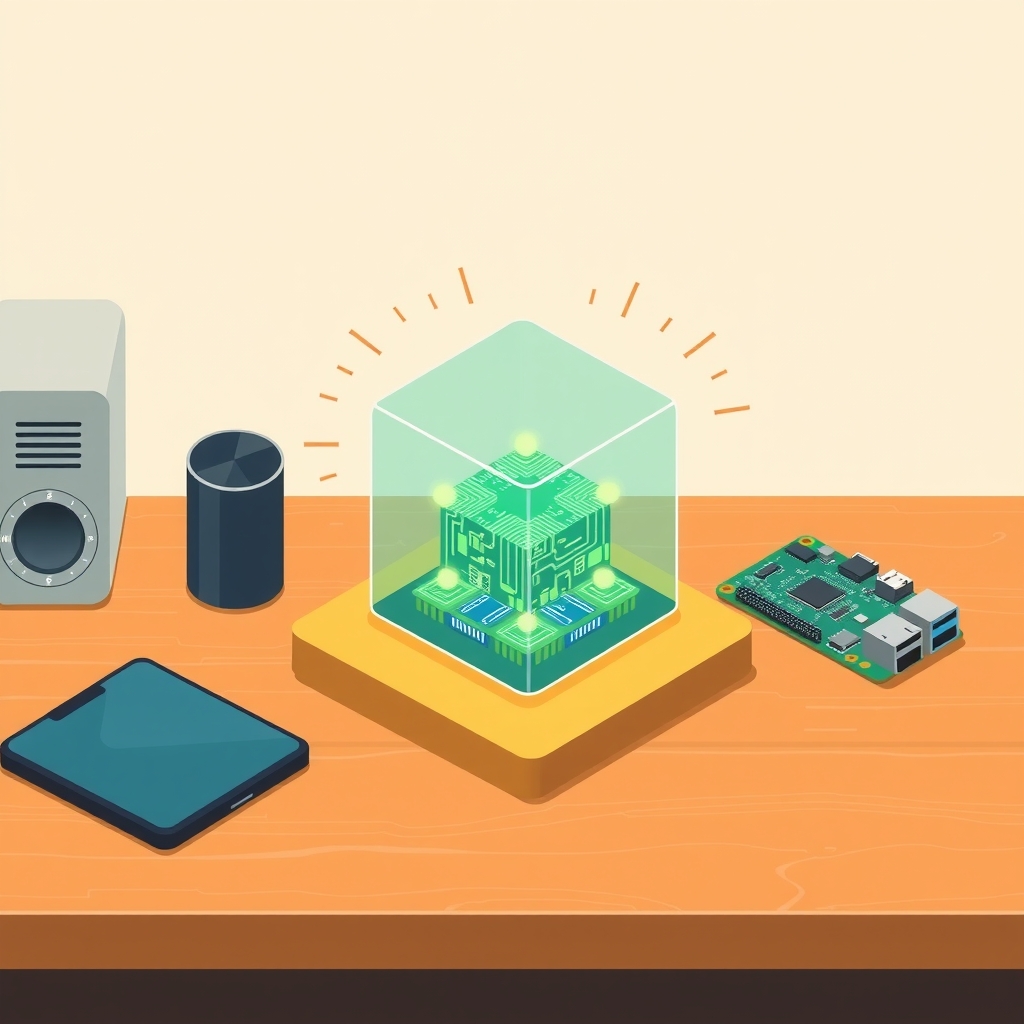
Hugging Face has released LFM3, a new suite of open-weight foundation models designed specifically for specialized intelligence on edge devices. Announced in late October 2026, this third generation of Liquid Foundation Models consolidates text, vision, audio, and decision-making capabilities into a shared backbone that fits within the 2 billion parameter range. The release targets developers who need to run capable AI locally on hardware ranging from smartphones to Raspberry Pi units without relying on cloud infrastructure.
What happened
The core of this release is LFM3-1.7B-Base, a model that serves as the starting point for six specialized variants. Unlike previous iterations that required larger parameter counts to achieve competitive performance, LFM3-1.7B outperforms its predecessor, LFM2.5-2.6B, while using 35% fewer parameters. This efficiency gain allows each modality-specific model to remain small enough for single-GPU fine-tuning and local deployment. The family includes dedicated models for text, vision, audio, and an omni-modal variant, along with two decision-focused models calibrated for specific outputs.
A significant shift in this generation is the unified training approach. All six models branch from the same 1.7B-parameter base, which was pre-trained on 22 trillion tokens. The final stage of training involved 3.5 trillion curated tokens with a heavy emphasis on agentic traces and tool calls. This preparation extends the context window to 256,000 tokens, enabling complex, long-horizon tasks to run entirely on-device. The result is a ecosystem where developers can select a model that matches their input data type, customize it with proprietary data, and deploy it directly where the application runs.
How it works
LFM3 achieves its performance through a tri-hybrid architecture discovered via hardware-in-the-loop search across 14 device and backend combinations. The base model consists of 24 layers that mix three distinct mechanisms: 13 gated short convolutions, 5 sliding-window attention layers, and 6 global attention layers. The convolutions use a kernel size of 7, an increase from 3 in LFM2, to capture broader local patterns efficiently. Sliding-window attention handles recent context with a 256-token window, while global attention manages long-range dependencies.
Several technical innovations further optimize the model for quantization and speed. Head-wise gated attention uses a sigmoid gate to scale each head's output, allowing inactive heads to switch off and reducing activation outliers that often disrupt low-bit precision. Partial Rotary Positional Embedding (RoPE) is applied only to the highest-frequency half of each head in global attention layers, ensuring content matching remains robust regardless of distance. Additionally, a sandwich normalization technique scales both input and output activations in each block to maintain stability during inference.
For non-text modalities, Hugging Face introduced new in-house encoders. The vision encoder combines convolution and attention, requiring 2.2 times fewer floating-point operations than comparable encoders while maintaining accuracy. It processes video by embedding pairs of sampled frames into single temporal slices, effectively halving the sequence length. The audio encoder is fully causal, enabling prefilling while the user speaks, with a time-to-first-token as low as 50 milliseconds. A new audio tokenizer, LiquidCodec, converts generated tokens into speech at approximately 87 times real-time speed on a single CPU thread.
Key details
- LFM3-1.7B-Base contains 24 layers with a tri-hybrid mix of convolutions, sliding-window attention, and global attention.
- The text model fits in approximately 1 GB of memory at 4-bit precision, making it viable for mobile deployment.
- Six specialized models are available: text, vision, audio, omni, and two decision models (d1-2B and d1-omni-2B).
- The vision encoder uses 3x less compute than SigLIP2 and matches Qwen3.5-2B's vision encoder accuracy with significantly fewer FLOPs.
- Audio processing supports streaming decoding via LiquidCodec, achieving 87x real-time speed on Apple M4 Max CPUs.
- On the WebArena-Verified benchmark, LFM3-1.7B scores 38.42, surpassing LFM2.5-2.6B's score of 3.02 and beating Qwen3.5-9B on long browser tasks.
Why it matters
For software engineers building on-device AI, LFM3 removes the traditional trade-off between model capability and hardware constraints. The ability to fit a competent multimodal model into 1 GB of memory means that intelligent agents can operate offline, preserving user privacy and eliminating latency associated with cloud round-trips. This is particularly critical for applications in sensitive environments or regions with unreliable connectivity, where local processing is not just a convenience but a requirement.
The focus on agentic workflows also signals a shift in how edge models are evaluated. By optimizing for tool calling and long-context retention, LFM3 enables local agents to navigate complex business applications and web browsers autonomously. Developers no longer need to stitch together separate models for perception and reasoning; instead, they can fine-tune a single backbone to handle multi-step tasks. This simplification reduces engineering overhead and accelerates the deployment of specialized AI solutions in resource-constrained environments.
What you can do
- Install the latest version of the
transformerslibrary to access LFM3 models directly in your Python environment. - Evaluate LFM3-1.7B for local agent tasks, particularly those requiring structured outputs or tool integration.
- Fine-tune the base model on your proprietary dataset using a single GPU to adapt terminology and behavior to your domain.
- Test the vision encoder with video inputs to leverage the reduced temporal sequence length for faster processing.
- Experiment with the audio encoder’s causal design to build real-time speech interfaces with minimal latency.
- Review the model cards for each of the six variants to determine which input-output combination best fits your application architecture.