Gemini 4 Argon vs. Claude Opus 5.5: A practical accuracy and cost comparison
A hands-on test reveals that while Gemini 4 Argon is half the price of Claude Opus 5.5, it struggles with complex reasoning tasks despite matching performance on code debugging.
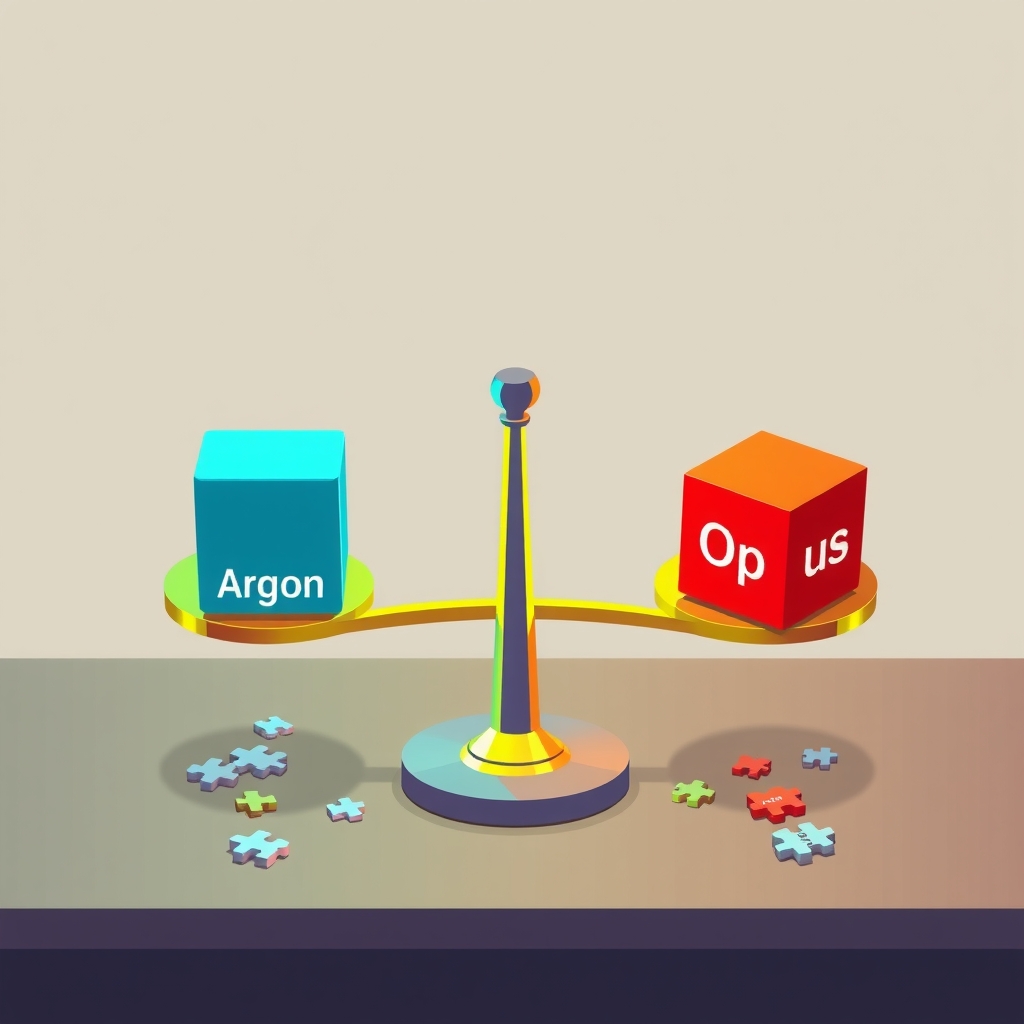
Google released Gemini 4 Argon to paid API developers on October 13, 2026, positioning it as a cost-effective alternative to Anthropic’s Claude Opus 5.5. While Google claims superior benchmark performance, independent testing reveals significant gaps in accuracy for complex logical tasks despite the lower price point.
What happened
Google announced Gemini 4 Argon on September 30, 2026, presenting data that showed the model outperforming Claude Opus 5.5 on 14 of 18 standard benchmarks. These included DeepSWE, where Argon scored 77.9% compared to Opus’s 74.2%, and GraphWalks at large context sizes, where Argon achieved 84.2% against Opus’s 66.8%. However, Google acknowledged that Opus 5.5 retained the lead in four other areas, notably Terminal-bench 4.0, which evaluates agentic command-line work.
To attract early adopters, Google set introductory pricing for Argon at $2 per million input tokens and $10 per million output tokens through November 30, 2026. This is exactly half the current rate for Claude Opus 5.5. On December 1, 2026, the price will double to $4 and $20 respectively, matching Anthropic’s rates. This six-week window provides developers a limited period to evaluate whether the cost savings justify any potential trade-offs in model capability.
Independent testing conducted via OpenRouter compared the two models on three specific, high-difficulty tasks. The results diverged sharply from Google’s aggregate benchmark claims. While Argon matched Opus in code debugging efficiency, it failed significantly in structured specification implementation and long-context logical reasoning, raising questions about its reliability for production systems requiring high precision.
How it works
The evaluation methodology involved running each test once per model using default reasoning settings. Answers were graded against pre-verified keys that included additional scoring criteria to ensure thoroughness. This approach isolates specific failure modes rather than relying on broad, averaged benchmark scores that may mask critical weaknesses in niche scenarios.
A key technical difference observed was in token usage and reasoning visibility. Claude Opus 5.5 consistently used more tokens for output, often engaging in explicit step-by-step reasoning before providing a final answer. Gemini 4 Argon tended to produce shorter responses with fewer output tokens, skipping visible chain-of-thought processes. While this reduced cost and latency, it correlated with higher error rates in complex logical tasks, suggesting that the skipped reasoning steps were necessary for accuracy in those specific domains.
Key details
- Code Debugging: Both models identified all 14 planted logic bugs in a 3,500-line Python library without flagging decoys. Argon was cheaper, costing an average of 1 cent per bug found versus 2.4 cents for Opus.
- Billing Specification: Claude Opus 5.5 passed all 80 hidden tests and 100 follow-up tests. Gemini 4 Argon passed only 11 of 80 initially due to a single incorrect argument in a
datetime.combine()call, which cascaded into widespread failures. - Long Context Reasoning: In a test involving 400 services, Opus correctly identified 33 dependent services in a blast radius analysis at 500K tokens. Argon identified only 20 correctly with 8 wrong entries, and its accuracy did not improve consistently with larger contexts.
- Token Efficiency: Argon used significantly fewer input and output tokens across tests. For the long-context test at 500K, Argon used 264 output tokens compared to Opus’s 5,532, reflecting its lack of visible reasoning steps.
- Pricing Window: Argon is currently half the price of Opus 5.5, but this discount expires on December 1, 2026, after which prices will be identical.
Why it matters
For engineering leads and technical founders, this comparison highlights the risk of relying solely on vendor-provided benchmarks. Aggregate scores like DeepSWE or GraphWalks may not reflect performance on specific business-critical tasks such as financial logic implementation or dependency mapping. The failure of Argon in the billing spec test due to a single syntactic error demonstrates how fragile cost-saving models can be when they lack robust error handling or deep contextual understanding.
The difference in reasoning behavior also has practical implications for system design. Models that skip chain-of-thought processing may offer lower latency and costs, but they provide less observability into their decision-making process. This makes debugging and trust calibration more difficult. As prices equalize in December, the choice between these models will depend less on cost and more on the specific accuracy requirements of the workload, particularly for tasks involving complex state tracking or multi-step logical deduction.
What you can do
- Test specific workflows: Do not rely on general benchmarks. Run your own critical paths, such as billing logic or dependency graphs, against both models before committing.
- Monitor token usage patterns: High output token counts may indicate useful reasoning steps. Consider whether skipping these steps saves money or sacrifices necessary accuracy.
- Plan for price changes: Factor in the December 1, 2026 price increase for Gemini 4 Argon when calculating long-term ROI. The current half-price advantage is temporary.
- Implement fallback mechanisms: If using a cost-optimized model like Argon, add validation layers or secondary checks for high-stakes outputs like financial calculations.
- Evaluate error types: Distinguish between minor syntactic errors and fundamental logical failures. Argon’s long-context errors were structural, not just superficial.
- Consider hybrid approaches: Use cheaper models for initial code review or simple tasks, and reserve higher-cost models for complex reasoning or specification generation.